
jeudi 7 août 2008

En route pour le Portugal / Let's go to Portugal
Ca fait maintenant deux jours que nous sommes à Bayona, une escale sympa. Le mouillage est juste à côté du port, en face de la vieille ville, pratique pour se balader et faire le ravitaillement. Depuis que nous sommes en Espagne nous avons toujours pu nous mettre à l'ancre, c'est quand même un bon esprit, en France ou en Grande Bretagne il aurait été difficile voir impossible d'éviter le ponton ou le mouillage payant.
Demain matin nous partons pour le Portugal, 12h ou 24h de nav (Leixoes à côté de Porto ou Nazaret)on verra. Après on va essayer de descendre plus vite car les vents sont à partir de maintenant bien établis de Nord.
It's been two days now that we are enjoying our stop in Baiona. The anchoring is very close to the marina and in front of the old city, very convenient for victualling and sightseing. Since we arrived in Spain, we always had the option to anchor, it's rather a good spirit here, in France or UK it would have been difficult even impossible to avoid going to the pontoon or pay for mooring.
Tomorrow morning we leave for Portugal, 12 or 24 hours sailing (Leixoes near Porto or Nazaret), we'll see. After we'll try to go south faster, now North winds are well established and strong.
mercredi 6 août 2008


Finisterre- Bayona : enfin on avance !
 1er août vers 11h, départ du sympathique petit bled de Finisterre très fréquenté par les touristes, et allumés venus de partout faire la marche de Saint Jacques de Compostelle ; pour la première fois depuis que nous sommes en Espagne, la météo annonce du vent de N-NO sur notre zone, idéal pour descendre ! Pourtant on ne fera que 24milles avec un vent de force 4 pour arriver à la Ria voisine de Muros en début d’après-m. Le mouillage dans le port de Muros n’est pas très accueillant, venteux et pas très bien situé ; on décide d’aller mouiller dans l’anse de Bornalle pas très loin. Pour y aller, il faut traverser un parc de rangs serrés de viveros , ces espèces de viviers flottants délabrés, parfois surmontés d’une cabane. Bornalle est beaucoup plus calme, mouillage juste devant la plage encore préservée de construction trop moches et bordée de pins et d’eucalyptus.
Le lendemain : on a assez trainé, il faut tracer. Départ à 8h30, pétole et roulis jusqu’à midi, heure à laquelle le vent de N-NE se lève et s’établit force 5, nickel on avance à plus de 6 nœuds de moyenne. On passe devant les rias d’Arosa, Pontevedra et devant l’ile Ons. On arrive un peu avant 17h au mouillage le plus fréquenté des îles Cies, la Playa Arena das Rosas de l’île de Faro [soit 40Milles]. Les jolies trois îles Cies font partie du parc naturel des îles atlantiques de Galice, il y a peu d’habitants, pas de voitures, pratiquement pas d’infrastructures touristiques (à part un camping basic) et de nombreuses zones de l’île sont interdites et réservées à la vie sauvage. L’île sud Saint Martin est théoriquement interdite de débarquement.
 L’Isla del Norde et l’Isla de Faro sont reliées par un isthme de sable et une petite digue en béton parallèle qui est envahie en fin de journée par les amateurs de couchers de soleil. Sur le point culminant de l’île, là où est installé le phare on a un super point de vue (voir diaporama). Nous passons une nuit sur place et le lendemain quand le vent se lève en début d’après-midi nous partons pour Bayona, notre plus courte nav : 8 Milles.
Cette ville touristique a gagné sa place dans l’histoire pour avoir été le port où accosta Christophe Colomb après son retour d’Amérique. La réplique de sa caravelle, « La Pinta » trône en permanence dans le port, elle me semble vraiment petite pour avoir effectué un tel voyage et dans les conditions de l’époque. Je crois qu’on va, pour une fois, aller se mêler à la masse des touristes pour aller visiter ce bateau qui a contribué à infléchir l’histoire de manière dramatique.
Finisterre to Baiona: at last we’re moving forward!
 On August 1rst, around 11am, we left the friendly little town of Finisterre, full of tourists and freaks from everywhere come for the Santiago de Compostela trek. For the first time since we arrived in Spain, the weather oracles promise N-NW wind in the area, just what we need to go south! Nevertheless, we’ll be lazy again and sail only 24miles with a wind force 4, to the next ria of Muros where we arrive in the beginning of the afternoon. The mooring zone in the harbor of Muros is windy, shaky and not very well located, we decide to go to the nearby Bornalle bay. On the way we have to go through a large park of dozen of viveros (sort of afloat crumbling fishponds). Bornalle is much quieter, we drop the anchor less than 100m from the beach, still exempt from ugly buildings and lined with pines and eucalyptus forest.
The next day: enough rest, we have to move forward! At 8:30am we set sail, there’s no air and we suffer an uncomfortable swell till midday when the wind decides to start blowing N-NE and settles at force 5. Perfect! We are going at more than 6 knots on average. We pass by the rias of Arosa and Pontevedra and the Ons Island. We arrive by 5pm at the busiest anchoring place of the Cies Islands, the Playa Arena das Rosas of the Faro Island. We’ve sailed 40Miles today, not bad...
The beautiful three Cies Island belongs to the Atlantic Island natural park of Galicia; there are only few inhabitants, no cars and almost no touristic infrastructure except a basic campsite. The major part of the island is restricted area, reserved for wildlife (essentially sea birds), the third and southern island, Isla de San Martin is closed to visitors. The Isla del Norde and the Isla de Faro are connected by a sand isthmus and a concrete dyke where sunsets lovers are gathering at the end of the day.

From the highest point of the island where the lighthouse is located you get a stunning panorama (see the slide show). We stay overnight and the next day we wait for the temperature to rise and make the wind blow, we leave for Bayona: our shortest sailing so far (8Miles).
This touristic city has won its place in history for being the harbor where Columbus Christopher landed on his way back from newly discovered America. A replica of his caravel “The Pinta” is permanently showing off in the harbor. She seems really small for such a trip, with the 15th century conditions. I think that, for once, we’ll join the mass of tourists and pay a tour on this ship which contributed to change history so dramatically.
samedi 2 août 2008
L’autre Finistère
 Le 1er août, départ de Camariñas à 8h30, le vent s’est calmé mais est toujours S-SO en plein dans le nez. Normalement l’été en Galice, les vents dominants sont de N-NE : on n’a vraiment pas de bol, on a fait que du près depuis qu’on a franchi le Golfe de Gascogne. Notre objectif c’est la Ria de Muros, après le cap Finisterre soit 42M en ligne droite, mais il va falloir tirer des bords. La météo annonce du vent même jusqu’à force 6 au moins on avancera ! Tu parles, force 3 ouais et avec de la houle, ca use ! C’est interminable en plus on choisit de passer large pour éviter tous les dangers de la côte, on va finalement opter pour un arrêt à Finisterre, le petit port de pêche derrière le cap, on a déjà parcouru une quarantaine de milles (avec l’aide du moteur sur la fin car en plus le vent s’est cassé la gueule) et il est déjà 22h et il bruine… Enfin c’est déjà un autre cap de passé !
Parenthèse géographique, en fait le cap Finisterre n’est pas le point le plus à l’ouest de l’Espagne, c’est le cap Toriñana juste avant.
Finisterre Cape:
 The first of August we left Camariñas at 8:30am, the wind has weakened but it’s again S-SW, still head wind. Usually in summer in Galicia, winds are N-NE: it’s really bad luck, we’ve been sailing against the wind since we passed Biscay. Our objective of the day is the Ria of Muros after the Finisterre Cape, exactly 42M on the chart, but we will have to tack again. The weather forecast says there will be wild till force 6; at least we’ll have some air! You bet! It’s been maximum force 3 and with a big swell, it’s really exhausting. It’s becoming endless, also because we chose to stay far from the shore to parry all the dangers. Finally we decide to stop at Finisterre, the small fishing harbor behind the cape, we have already covered about 40M (with the motor at the end because the wind has weakened again), it’s already 10pm and it’s drizzling… At least it’s another cape we’ve passed!
Geographical note: in really the Finisterre Cape is not the westerner point of Spain, it’s the Toriñana Cape just few miles up north of it.
jeudi 31 juillet 2008
Camariñas
We haven’t changed our habits: it’s with pinched wind that we sailed from Laxe to Camariñas. After hard rain in the morning, sun has been with us all day long (sun burn on legs), wind SW force 3. It was only 22Miles in theory but more probably 28 with all the bends to avoid reefs and especially a shoal “Leixon de Juanboy” we discover just before we arrived (it was not indicated on the map of the pilot chart, only mentioned in a warning in small letters), about 10 hours in total. Camariñas is a rather little ria with a point of interest for me: plenty of wind mills in every directions! So, right the next morning we went for a walk to the « parco de eolico de Vilan » on the hills above Camariñas, with flip-flops of course (big blister!). The winds mills seemed pretty close but in fact they were just really big!
 We’ve also seen most of competitors of the “Solitaire du Figaro” race, who came here to refuel before going to Vigo…with the motor!! We are moving on quite slowly, making baby steps, but we are not very excited by doing long distances with wind in the nose and the “Portuguese trade winds” are still far away…
Grrr… still anchored in front of the harbor of Camariñas which became less welcoming yesterday, wind has freshened and always S S-W. Weather was bad, we spent the day inside the boat reading books and cooking up nice meals. The anchor already slipped once and we watched late in the night before going to bed for a light sleep, with the alarm clock set at 4:15am for high tide! We slept badly but the anchor didn’t move. Around 10am, as the wind has freshened again to force 7 (our Belgian flag has been torn), Ludo decided that doubling the rope that hangs the anchor chain would be safer. During the exercise Ata Jata bluntly slips straight toward the superb 54 feet yacht moored behind her but no problem, our veteran MD2B Volva Penta motor is working now. We drop the anchor again a little bit further. Gusts, showers…we’ll wait until it’s getting better, contemplating the acrobatics of our flying dinghy which has become the attraction of the mooring zone.Pour ne pas changer les bonnes habitudes, c’est au près qu’on a fait Laxe-Camariñas. Heureusement après une drache matinale, il a fait beau tout du long (coup de soleil sur les tibias), vent SO force 3, c’était seulement 22 Milles en théorie mais probablement plutôt 28 avec les bords qu’on a dû tirer pour éviter tous les cailloux, et un petit détour juste avant d’arriver pour éviter Leixon De Juanboy un haut fond découvert juste avant (il n’apparaissait pas sur notre plan d’approche mais était signalé dans un avertissement !), en tout une dizaine d’heures. Camariñas c’est assez sympa, une petite ria avec un intérêt pour moi : la patate d’éoliennes dans toutes les directions ! 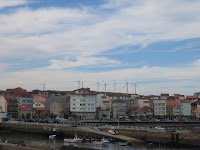 Donc, dés le lendemain matin, visite du « parco de eolico de Vilan » sur les hauteurs de Camariñas, en tongs of course (aie vilaine ampoule !), elles n’avaient pas l’air loin mais en fait c’est qu’elles étaient super grandes ces éoliennes. On a aussi vu défiler dans le port les participants à la solitaire du figaro venus se réapprovisionner en gasoil pour rallier Vigo… au moteur !! On ne progresse pas très vite, on fait des sauts de puce car faire des longues distances au près ça nous motive pas trop et les « alizés portugais » sont encore loin…
Toujours au mouillage devant le port mais hier Camariñas est devenue moins accueillante, le vent souffle de plus en plus fort toujours S S-O. Il fait gris, une journée dans le bateau à bouquiner et à se faire des bons petits plats. Le mouillage a déjà dérapé une fois et on veille tard avant de se coucher sur une seule oreille, avec réveil à 4h15 du mat pour la marée haute. On dort mal mais on ne dérape pas. C’est vers 10h du mat, alors que le vent a encore augmenté force 7 (notre drapeau belge s’est arraché) que Ludo décide de doubler le cablot qui tient la chaine, là on dérape direct droit le superbe 54 pieds mouillé juste derrière nous, mais pas de problème MD2B, notre fidèle moteur est là ! On jette l’ancre plus loin. Rafales, pluie …on attend que ça passe en admirant les cabrioles de notre annexe qui est l’attraction du mouillage.
 We’ve also seen most of competitors of the “Solitaire du Figaro” race, who came here to refuel before going to Vigo…with the motor!! We are moving on quite slowly, making baby steps, but we are not very excited by doing long distances with wind in the nose and the “Portuguese trade winds” are still far away…
Grrr… still anchored in front of the harbor of Camariñas which became less welcoming yesterday, wind has freshened and always S S-W. Weather was bad, we spent the day inside the boat reading books and cooking up nice meals. The anchor already slipped once and we watched late in the night before going to bed for a light sleep, with the alarm clock set at 4:15am for high tide! We slept badly but the anchor didn’t move. Around 10am, as the wind has freshened again to force 7 (our Belgian flag has been torn), Ludo decided that doubling the rope that hangs the anchor chain would be safer. During the exercise Ata Jata bluntly slips straight toward the superb 54 feet yacht moored behind her but no problem, our veteran MD2B Volva Penta motor is working now. We drop the anchor again a little bit further. Gusts, showers…we’ll wait until it’s getting better, contemplating the acrobatics of our flying dinghy which has become the attraction of the mooring zone.
 Donc, dés le lendemain matin, visite du « parco de eolico de Vilan » sur les hauteurs de Camariñas, en tongs of course (aie vilaine ampoule !), elles n’avaient pas l’air loin mais en fait c’est qu’elles étaient super grandes ces éoliennes. On a aussi vu défiler dans le port les participants à la solitaire du figaro venus se réapprovisionner en gasoil pour rallier Vigo… au moteur !! On ne progresse pas très vite, on fait des sauts de puce car faire des longues distances au près ça nous motive pas trop et les « alizés portugais » sont encore loin…
Toujours au mouillage devant le port mais hier Camariñas est devenue moins accueillante, le vent souffle de plus en plus fort toujours S S-O. Il fait gris, une journée dans le bateau à bouquiner et à se faire des bons petits plats. Le mouillage a déjà dérapé une fois et on veille tard avant de se coucher sur une seule oreille, avec réveil à 4h15 du mat pour la marée haute. On dort mal mais on ne dérape pas. C’est vers 10h du mat, alors que le vent a encore augmenté force 7 (notre drapeau belge s’est arraché) que Ludo décide de doubler le cablot qui tient la chaine, là on dérape direct droit le superbe 54 pieds mouillé juste derrière nous, mais pas de problème MD2B, notre fidèle moteur est là ! On jette l’ancre plus loin. Rafales, pluie …on attend que ça passe en admirant les cabrioles de notre annexe qui est l’attraction du mouillage.
samedi 26 juillet 2008
Re-Laxe
We left Ares yesterday morning at 9:00, weather was ugly, grey, and drizzly and there’s not even a slight breeze. We had to use the motor for 3hours to exit the bay and our heads ache. Beginning of the afternoon, at last we got some sun and wind but it’s blowing exactly from where we’re heading. From now on Ludo will have to manage on his own, I’ll be sick almost until we arrive. After some time it’s raining hard, the sea was chaotic, and the boat was bouncing up and down in the waves, beurk…The wind has freshened to force 5 but the fog has fallen all over the coast and it’s hard to see where is the entrance of the Ria of Corme/Laxe? Finally around 9pm (12hours for 40M!), we entered the ria, it looks very well preserved, green and hilly. On July 25, it’s Galicia Festival, Saint Jacques festival; 1km away from the shore we can already smell paella and BBQ! 
The port of Laxe is a small fishing harbor protected by a huge water break, dominated by a 14th century church and lined by a nice beach with dunes. This region is known for been very dangerous and is called the “Coasta del Morte”. Each year in the harbor, there’s a fiesta for locals, re-making a famous shipwreck. Today will be sun bathing and walk, tomorrow if the wind is generous we’ll sail to Camarinas the next ria.

The port of Laxe is a small fishing harbor protected by a huge water break, dominated by a 14th century church and lined by a nice beach with dunes. This region is known for been very dangerous and is called the “Coasta del Morte”. Each year in the harbor, there’s a fiesta for locals, re-making a famous shipwreck. Today will be sun bathing and walk, tomorrow if the wind is generous we’ll sail to Camarinas the next ria.
Re-Laxe
Départ de Ares hier à 9h du mat’, il fait moche, gris, il bruine, pas de vent…c’est parti pour 3 heures de moteur qui casse la tête. En fin de matinée, enfin un peu de soleil et de vent mais on est au près. A partir de là, Ludo va se débrouiller tout seul car moi je vais être malade presque jusqu’à l’arrivée. Il pleut, la mer est hachée et on tape dans les vagues, beurk…Le vent se lève jusqu’à force 5 mais la brume tombe sur la côte et dur de dire où est l’entrée de la Ria de Corme/Laxe ? Vers 21h, on entre enfin dans la Ria, ça a l’air assez bien préservé, très vert et vallonné. Aujourd’hui c’est la fête de la Gallice, celle de Saint Jacques, à 1km de la côte ça sentait déjà la paëlla et la merguez !
 Le port de Laxe est un petit port de pêche protégé par un gros brise lame, dominé par une église du XIVéme et bordé d’une jolie plage avec des dunes. La région est apparemment célèbre pour ses fortunes de mer au point qu’on l’appelle la «Costa del Morte », il y a même une fête-reconstitution chaque année dans le port d’un naufrage célèbre. Aujourd’hui c’est bronzette et balade, demain si le vent le veut bien on poussera jusqu’à Camarinas la Ria voisine.
 Le port de Laxe est un petit port de pêche protégé par un gros brise lame, dominé par une église du XIVéme et bordé d’une jolie plage avec des dunes. La région est apparemment célèbre pour ses fortunes de mer au point qu’on l’appelle la «Costa del Morte », il y a même une fête-reconstitution chaque année dans le port d’un naufrage célèbre. Aujourd’hui c’est bronzette et balade, demain si le vent le veut bien on poussera jusqu’à Camarinas la Ria voisine.
Inscription à :
Articles (Atom)